The ExPat Returneth

Showing posts with label Chinese food. Show all posts

Wednesday, March 7, 2012

Quick & Easy Japanese Food: Mabodofu (Tofu & Ground Meat)

MABODOFU: HAVE YOUR MEAT AND EAT TOFU, TOO


Today I present a tofu dish, another Japanese dish brought over from China and Japanified. Mabodofu (dofu = tofu) is a common meal at home and in Chinese restaurants. According to legend (and Wikipedia), a Japanese chef made mabodofu popular at the first Sichuanese restaurant in Tokyo in the 1950s. In China, it's made with spicy chili bean paste. In Japan, the recipe was modified for the milder Japanese palette. It's so common now in Japan, you can buy the Hamburger Helper equivalent in a grocery store (which is pretty good). It is one of the few dishes that our youngest will pick over noodles, which is a startling revelation if you knew her.


See all the meat? If you're vegetarian,
use a ground Bocca Burger type product
Yet, it's tofu and I know what you're thinking. It's tofu. 


Listen, my family likes tofu, but I was raised in a Midwestern farm town where we ate meat every day. If you offered me a choice between grilled steak and grilled tofu, I would choose the steak. I am not here to convince you to hang out in the tofu aisles of Whole Foods. Mabodofu is not even a vegetarian dish, generally it includes ground pork (although you can use ground beef or other ground meats). It has a rich gravy, which gives the tofu a savory flavor. And you use firm tofu which has enough bite and texture that it feels creamy without being squishy. 


Believe me, I do not like squishy.


A Mabodofu mix
bought in an Asain grocery
in the U.S.
First, the Hamburger Helper way. Here's a picture of a package of Mabodofu mix. You can get them in Asian grocery stores at different heat levels. (Mild has absolutely no heat). This is super simple. All you need is about a quarter pound of ground pork, a package of tofu, and green onions (you can actually leave the green onions out). Make some rice, saute the pork, add the sauce and cubed tofu, and you are done. Aside from the rice, it takes about 10 minutes. 


I know. 10 minutes. I'd double the recipe for an American family, though. It will cost you about $6 for two packages.


I cut & drain my tofu, but notice
my lack of style. No squeezing necessary.
For those of you who would like more control over the contents of your meal (the mix probably has MSG), JustBento.com has a great recipe. I've looked at other recipes and theirs is the simplest I've found so far. My family loved it. The ingredients are also pretty easy to find: tofu, ground meat, onions, miso paste (the soybean paste in miso soup), garlic, ginger, crushed red pepper, soy sauce, sesame oil, sugar, and water.


Go here for the JustBento.com recipe for Mabodofu.


Miso paste from U.S. Asian
grocery
I had never had onions in Mabodofu before, but they added extra flavor and texture. Sarah, the blogger who created this recipe, also used ground beef. Traditionally, the meat is ground pork, and I used ground pork when I made it. I also like the addition of miso. What's missing is the Chinese chili paste you normally see in Mabo recipes. The miso is used as sweet bean paste. 


I would NOT use a tablespoon of cayenne pepper unless you are a heat freak. I used a dash, which is plenty for my family's timid tastebuds. Sichuan Mabo Tofu is spicy, so let your tastebuds make your decision.


Wednesday, February 1, 2012

New Year's Dumplings (Also Good for the Superbowl!)

Today's "Quick and Dirty" recipe comes from my friend who hosted the Japanese New Year party I wrote about in the last blog entry. Her recipe is neither quick nor (in a Japanese kitchen) dirty, but so delicious I had to share. My friend warned me it took her an hour to make these by hand (and corrected my blog entry, she made 90!). For convenience sake, you can buy frozen gyoza in Asian food stores and other stores that carry Asian food, like Trader Joe's.

I'm also including my Quick and Dirty Gyoza recipe which begins with buying a bag of frozen, pre-made gyoza. 

You are welcome.

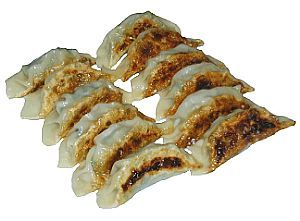
Like many foods in Japan, gyoza was imported from China and modified for the Japanese palette. We call them potstickers in the U.S. Similar to a ravioli, they are thin dough stuffed with filling, usually pork and vegetables, pressed to close and cooked. Chinese pan-fried jiaozi (guotie) tend to have thicker skins than Japanese gyoza and the fillings are slightly different, particularly the use of garlic in Japan. This particular form of dumpling is panfried and then steamed to finish, hence the translated name potsticker. 

In Japan, gyoza is a common bar food, ubiquitous appetizer, readily found in Chinese restaurants, and so popular certain restaurants are devoted to that one food. One of our favorite places to eat was called Gyoza No Osho, "Gyoza King", a kind of Chinese cuisine diner. We ate at another gyoza restaurant that featured about thirty different fillings including cheeseburger and pumpkin. It's difficult to find gyoza of this quality in the U.S., so we are forced to make it at home. Just Hungry also has a good gyoza recipe.

True Quick and Dirty Gyoza: 
Buy it frozen (directions are on the bag):

My husband likes to make it them a cast iron skillet for a crispier finish but any skillet will do.
 
Heat skillet on a medium high to high flame with about 1 T of oil. 
Cook frozen gyoza until browned on the bottom. 
Add 2 TB of water, cover, and turn the flame down to low for about 7-8 minutes.  

Eat immediately.

If dipping sauce is not included in the bag, mix 2 parts soy sauce to 1 part vinegar, add hot chili oil as you like.

Bam.

Not Quick but Truly Delicious And Worth the Trouble Homemade Gyoza: 
 
Gyoza skins can be readily found in Asian grocery stores and large supermarkets. Caveat: wonton wrappers (often used for eggrolls and other kinds of dumplings) are thicker than gyoza skins. This recipe is for gyoza skins. The round packs come frozen or refrigerated. For 1 lb. of ground pork, you will probably need about 2 packs.


1 lb. ground pork
 
1/2 bunch of chinese chive or garlic chives (these chives have a distinctive garlic flavor rather than onion. If you can't find them, you can use green onion instead)
 
1 lb. white cabbage  (napa cabbage)
 
2 TB soy sauce

2 TB Shioxing (or 1 TB of mirin and 1 TB of cooking sake) 

2 TB shiro-dashi (prepared base stock)

2-3 cloves of garlic, pressed or ground

1 TB fresh ginger, ground
 
1/3 TB  sugar

1 TB sesame oil 

1.Mince the chives and cabbage. Sprinkle with salt, toss, and set aside.
   
(キャベツとニラをみじん切りにして塩をふって混ぜ、しばらくおく)
 
2. Using a large bowl, sprinkle salt and pepper on ground pork and mix well until sticky.
 
(豚ひき肉と塩コショウを加え、ねばり気が出るまでよく混ぜる)
 
3.Squeeze out the chive and cabbage mixture tightly to remove as much water as possible and add to the pork.
 
(1のキャベツとニラの水気をしっかりしぼって豚ひき肉のボウルに加える)
 
4. Add a few dashes of salt and pepper, soy sauce, Shaoxing (or sake and mirin mixture), garlic, ginger, sugar, and shiro-dashi. Mix well. 

Finally, add the sesame oil and mix again.
 
(さらに塩コショウ、しょうゆ、紹興酒←かわりに酒&みりんでもOK、すりおろしにんにく、すりおろししょうがを少々、砂糖少々、白だし少々を加える)
 
 5.  Quoted from my friend's recipe, 
***I recommend to eat it the next day! You should keep it in fridge for 1night.***
 
6. Wrap about a teaspoon of the filling in a gyoza skin, folding diagonally and sealing edges by crimping or wetting with a dab of water. Traditional gyoza are crescent shape, but l
ike ravioli, you could experiment with the shape. The key is to make sure the skin is sealed.

7. Cook as you like. (See Quick and Dirty recipe above, but steaming will be much quicker, 5 minutes or less). You can pan fry or use in a soup.